Introduction: Why this topic matters today
SEO has changed a lot in the last few years. Earlier, we focused on keywords, backlinks and technical fixes. Now AI tools, AI-driven search results and new ranking styles are shaping how people discover content. Because of this shift, many people are confused about what still works, what has changed and where AI fits into the picture.
You’ll understand the real difference between AI SEO and Traditional SEO, how both work, what each one can do for you, and how to mix them in a smart way. We’ll also talk about GEO (Generative Engine Optimization) and AEO (Answer Engine Optimization), which are becoming important because of AI-based search.
What Is AI SEO?
AI SEO uses artificial intelligence tools to automate and speed up SEO tasks like research, content, analysis and optimization. It doesn’t replace humans but helps them work faster and better.
1. Understand search intent
AI reads millions of search patterns and understands why people search something and what exactly they expect.
2. Find better keyword groups
Instead of just keywords, AI tools create topic clusters, related questions, and deeper suggestions.
3. Create and improve content
AI helps you write content drafts, headings, outlines and variations quickly. (You still need a human touch to refine it.)
4. Optimize for AI-based search results
With AI overviews coming into search engines, content needs to be structured differently so AI tools can understand and use it.
5. Analyze data faster
AI tools scan large data sets in seconds and explain what you should fix, what is working, and what can perform better.
Faster content creation AI helps write drafts and ideas quickly, saving time.
6. Better keyword suggestions
AI tools find hidden keywords that humans may miss.
7. Real-time optimization
AI analyzes page quality, readability, intent and gives instant improvement tips.
8. Competitor analysis
AI checks what competitors rank for and how you can rank better.
9. Predicting what will rank
AI studies patterns and helps you understand what Google prefers.
AI SEO is fast, smart and very good for scaling large websites. But it always needs human review to keep quality high.
What Is Traditional SEO?
Traditional SEO is the method we all used before AI took over as a major tool. It is based on improving your website with the core pillars. Traditional SEO focuses on ranking your website on search engines using manual research and optimization.
Key Parts of Traditional SEO
Keyword research
You find the exact words people search and create content around them.
On-page optimization
You improve titles, headings, URL, meta tags and content to match search intent.
Technical SEO
You fix site speed, indexing, crawling issues, sitemaps and mobile-responsiveness.
Link building
You get backlinks from trusted websites to increase authority.
Manual content writing
Content is written fully by humans, using research and personal expertise.
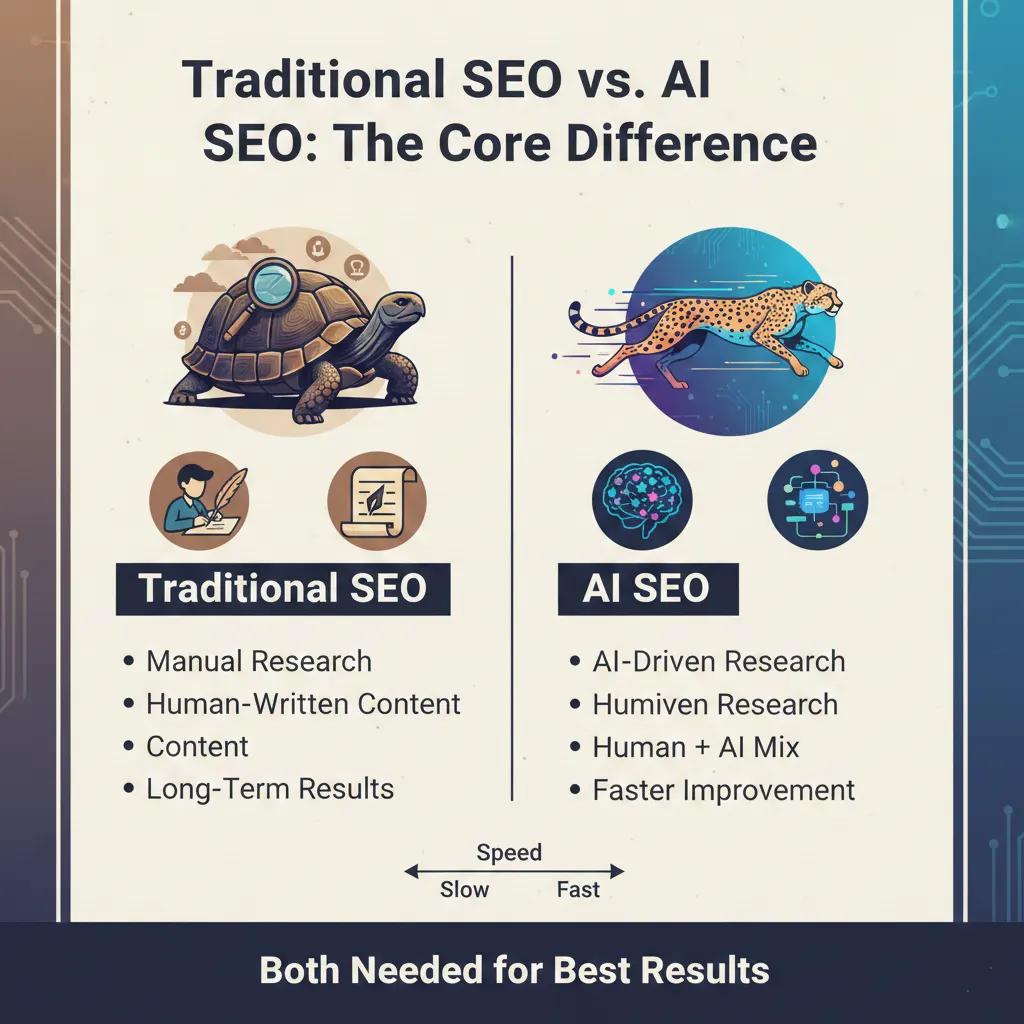
Quick Comparison for AI SEO vs Traditional SEO
| Feature | Traditional SEO | AI SEO |
| Speed | Slow | Fast |
| Research | Manual | AI-driven |
| Content | Human-written | Human + AI mix |
| Backlinks | Very important | Still important |
| Search intent | Basic | Deep understanding |
| Technical work | Manual auditing | AI auto-suggestions |
| Results | Long-term | Faster improvement |
Traditional SEO is manual and slow but stable. AI SEO is fast, data-driven and predictive.
Which AI Models Are Mostly Used in AI SEO?
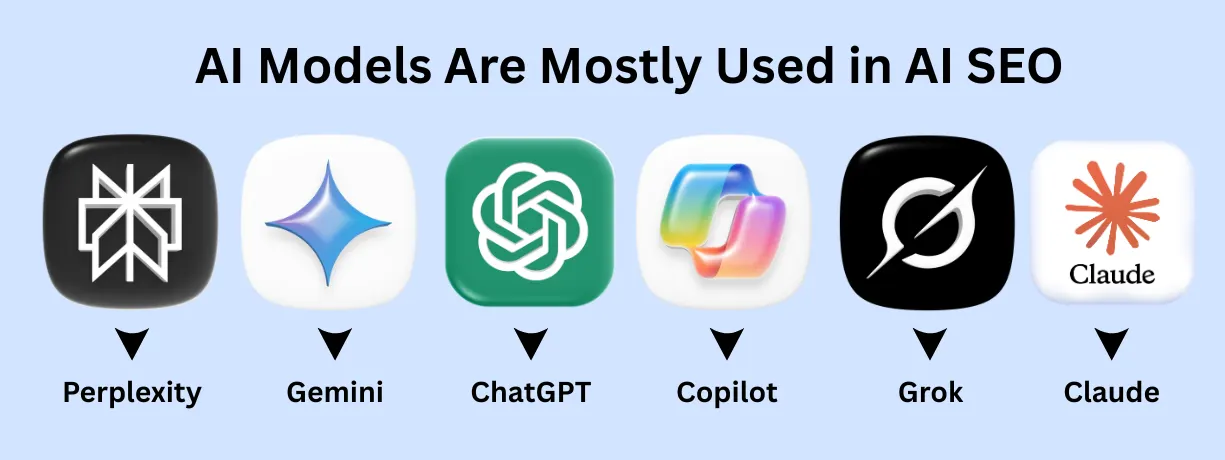
These are the common AI models used for research, writing and optimization:
1. ChatGPT
Used for writing drafts, ideas, outlines and simple content planning.
2. Google Gemini
Helpful for research, fact-checking and long-form content support.
3. Perplexity AI
Great for getting real-time answers and topic summaries.
4. Grok
Used for ultra-fast data processing and analysis.
5. DeepSeek
Popular for advanced keyword research, trends and SEO insights.
GEO & AEO: The New Kids in SEO
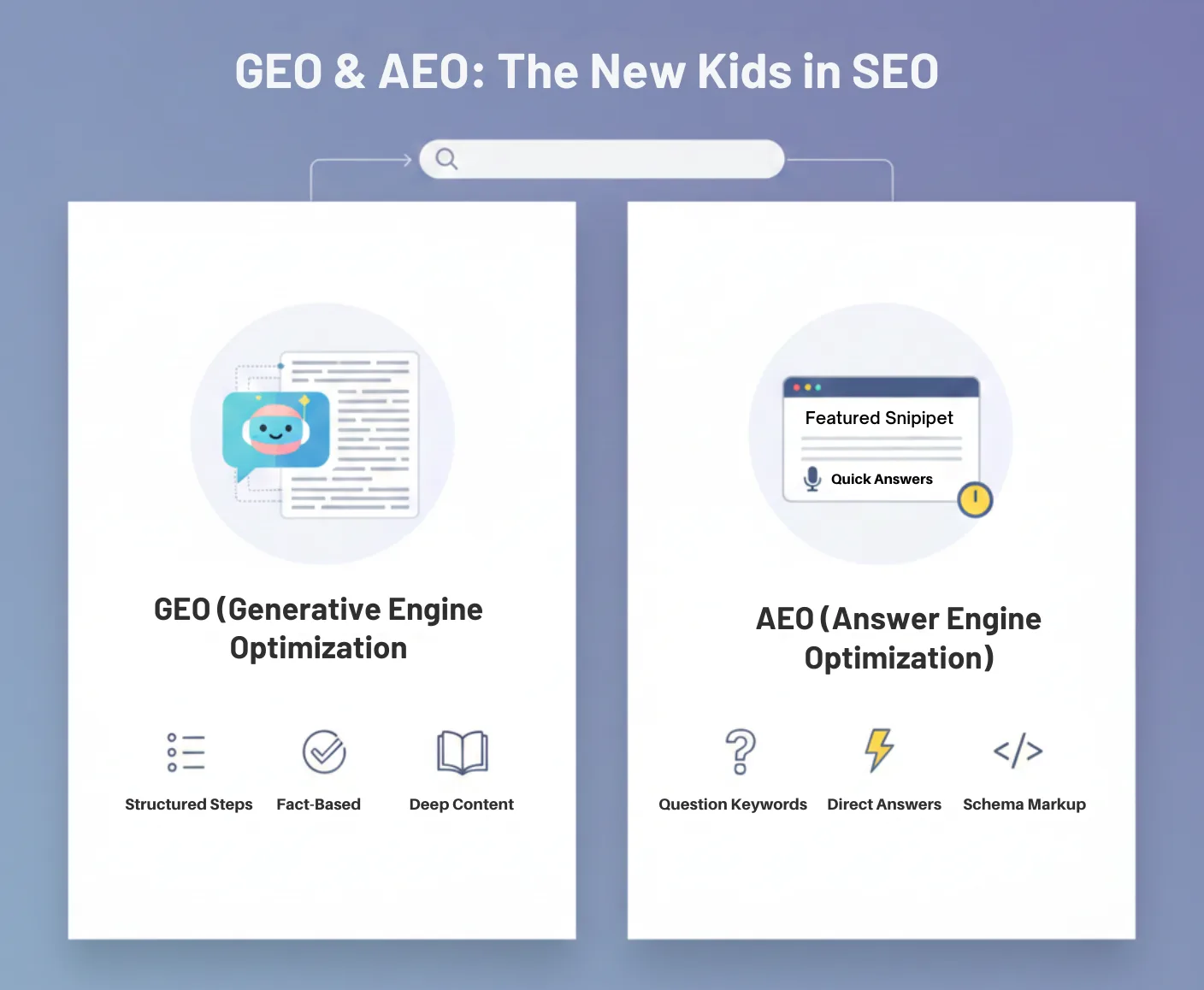
What is GEO (Generative Engine Optimization)?
GEO means optimizing your content for AI systems instead of only search engines. In simple words, it helps your content appear inside AI answers generated by tools like ChatGPT, Gemini, Perplexity and others.
How GEO Works
Structure content in clear steps
AI tools understand well-structured content and use it in their answers.
Write fact-based content
AI responds more with content that is accurate and clear.
Cover topics deeply
AI likes detailed explanations instead of short pages.
Use simple language
Clean and easy sentences help AI understand your content better.
What is AEO (Answer Engine Optimization)?
AEO focuses on ranking your content directly in answer boxes, voice search and AI summaries. It helps your content show up when someone asks a question to Google Assistant, Alexa, Siri or AI bots.
How AEO Works
1. Focus on question-based keywords
Example: “how to”, “what is”, “why does”.
2. Short and direct answers
Give the answer in 1–2 lines before explaining it.
3. Use schema markup
Helps Google understand your content better and create “featured snippets”.
4. Optimize for voice search
Write naturally like people speak.
Both GEO and AEO are becoming important because more people are using AI apps for search.
Why Backlinks, Technical SEO & E-E-A-T Still Matter
Even though AI is growing fast, Google still depends on some core SEO foundations. These signals help Google understand which websites are trustworthy, useful and safe.
1. Backlinks
Backlinks act like recommendations from other websites. When a reputable site links to you, it tells Google your content is valuable and reliable. AI tools can help you find backlink opportunities, but real trust comes only when actual websites choose to link to your content.
2. Technical SEO
No matter how smart AI becomes, a website with slow speed, broken links or indexing issues will always struggle to rank. Google rewards sites that load fast, are mobile-friendly and follow clean technical standards. AI can guide you, but the technical health of the site still needs proper setup and regular checks.
3. E-E-A-T (Experience, Expertise, Authoritativeness, Trustworthiness)
Google wants content that feels real, human and genuinely helpful. It looks for signs that the writer has experience, knows the subject well and can be trusted. AI can support the writing process, but human insights, real examples and expert opinions are what make the content truly credible.
What Should a Modern Business Choose?
The smartest approach is to use a mix of all four methods. Each one plays a different role and together they create a strong, future-proof SEO strategy.
Traditional SEO
Traditional SEO gives your website long-term trust and steady rankings. It focuses on quality content, backlinks and technical improvements — the things that still matter the most for sustainable growth.
AI SEO
AI SEO helps you work faster and more accurately. It speeds up research, writing and optimization so you can produce better content in less time without reducing quality.
GEO (Generative Engine Optimization)
GEO makes sure your brand appears in AI-generated answers from tools like ChatGPT, Gemini and others. This increases visibility even when people are not searching directly on Google.
AEO (Answer Engine Optimization)
AEO helps your content show up in quick answers, featured snippets and zero-click searches. Your brand still gets visibility even if users don’t visit your website.
How to Build an AI-Powered SEO Workflow
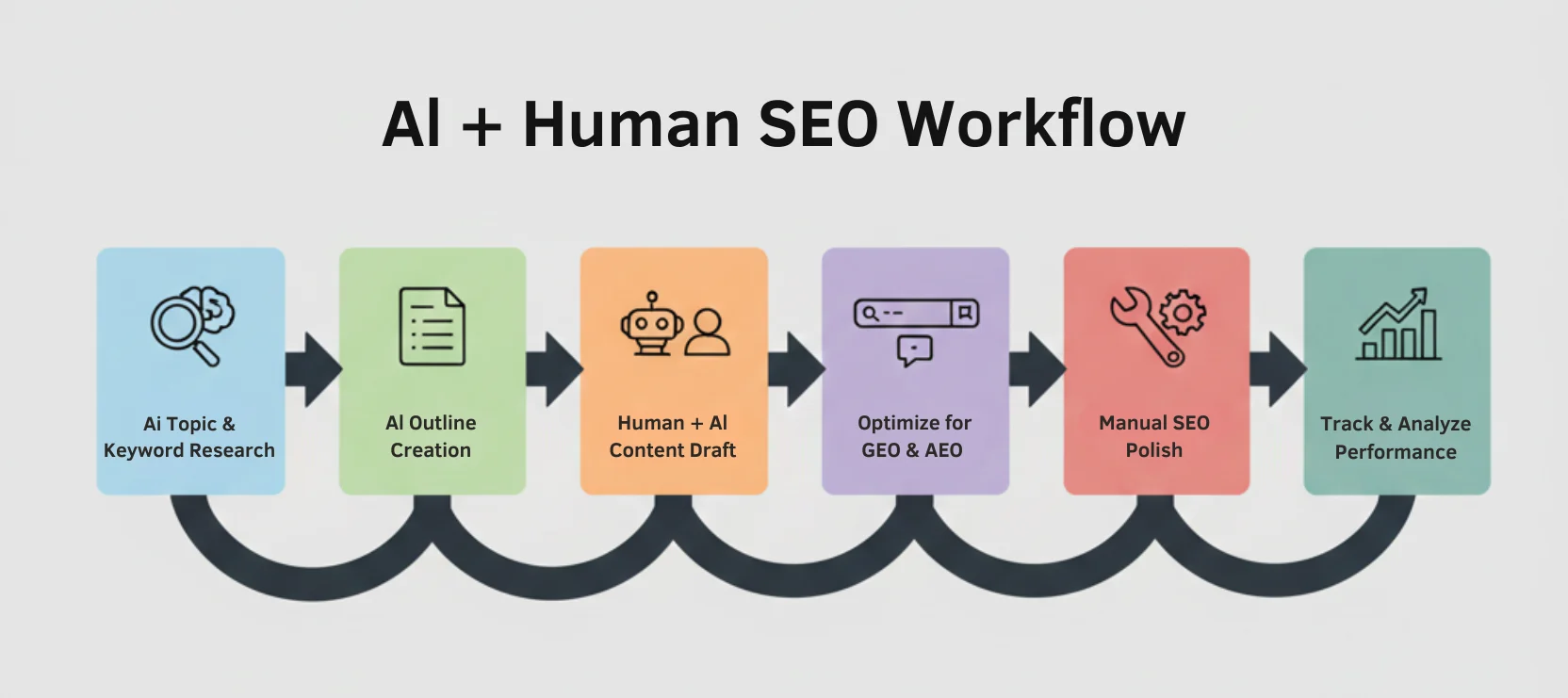
Here’s a practical workflow you can follow to mix AI and traditional SEO in a clean, effective way.
Step 1: Use AI for topic and keyword research
Start with AI tools to explore what people are searching for. They help you find topic clusters, understand search intent and discover common questions users ask. This gives you a strong base before you start writing.
Step 2: Create an outline with AI
Ask AI to arrange your ideas into structured headings Keep the outline simple and closely connected to your keyword plan so every section supports ranking.
Step 3: Write content with human + AI
Let AI create the first draft to save time. Then you refine it by adding real examples, natural tone and your own clarity. This keeps the content helpful and human.
Step 4: Optimize for GEO & AEO
Add short answer-style snippets to help AI models understand your content. Include FAQs, use bullet points and break the content into small readable sections. This increases your chances of appearing in AI responses and quick answers.
Step 5: Optimize manually for SEO
After the draft is ready, check all on-page elements. Add internal links, clean titles, strong meta descriptions, compressed images and make sure your page loads fast. These small updates improve both ranking and user experience.
Step 6: Track performance using tools
Use analytics tools to see how your pages are performing. Check rankings, impressions and clicks. Update your content regularly based on what the data shows.
Best Tools for AI SEO & Traditional SEO
Here’s a quick and easy way to understand which tools work best for each task.
For Research
- AI-based keyword tools: These tools help you discover new keyword opportunities, long-tail queries and search intent faster.
- Traditional tools for volume and competition: They give accurate numbers for search volume, keyword difficulty and competitor comparisons.
For Content
- AI writing assistants: They help you create outlines, drafts and ideas quickly.
- Human edits for quality: A human check keeps the content natural, correct and relatable.
For Technical SEO
- Crawlers: They scan your website to find broken links, indexing errors and technical gaps.
- Speed testing tools: These show how fast your pages load and what needs improvement.
- Security checks: Tools help detect SSL, malware or security issues that affect rankings.
For Performance Tracking
- Tools that show keyword movement: They help you see which keywords are going up or down in search results.
- Click-through-rate reports: These show how many users are clicking your result in Google.
- Traffic pattern tools: They help you understand which pages bring the most visitors and what needs improvement.
Risks of AI SEO (Things to Watch Out For)
AI is helpful, but it also has a few risks that you should be aware of while creating content.
AI may create wrong information
Sometimes AI misunderstands facts or mixes up details.
That’s why every line needs a human review before you publish it.
Tone may sound unnatural
AI text can feel flat or robotic if left unedited.
A quick human rewrite makes the content sound real and friendly.
Google may not trust fully AI-generated text
Search engines prefer content that shows real expertise and human understanding.
Pure AI writing may not perform well without human input.
Content may repeat from other sources
AI can accidentally generate lines that sound similar to what already exists online.
This affects originality, so you must check for uniqueness.
AI may miss real human examples
AI doesn’t always add personal stories or practical insights that real users relate to.
Human experience makes the content more trustworthy and useful.
Final reminder
AI should support your work, not replace it.
Always use it as a helper and keep the final control in your hands.
How to Measure AI SEO vs Traditional SEO
Here’s what you should track to see which approach is performing better:
Traffic
Check whether your website visits are increasing after using AI-driven methods or traditional optimization.
A steady rise shows your strategy is working.
Keyword ranking
See if your target keywords are moving higher in Google search results.
Better positions mean your content is becoming more relevant.
CTR (click-through-rate)
Measure how many people actually click on your page from the search listing.
A higher CTR shows your titles and descriptions are appealing.
Time on page
If users spend more time on your page, your content is engaging and answers their questions well.
Low time usually means the content needs improvement.
Bounce rate
A high bounce rate means visitors leave quickly without exploring further.
This often signals weak content, poor structure, or irrelevant information.
Conversions
Track actions like signups, purchases, or lead submissions to see real business results.
Strong conversions confirm your SEO is targeting the right audience.
How Ad Age Media Resources Helps
Ad Age Media Resources follows a balanced SEO strategy that blends traditional methods with the latest AI-driven techniques.
Traditional SEO for stable rankings
We focus on strong basics like keywords, on-page work, backlinks, and technical fixes. This helps your website build long-term trust and steady rankings.
AI SEO for fast and smart execution
AI tools speed up research, content planning, and optimization. This helps you work faster while keeping the content accurate and user-friendly.
GEO for visibility in AI systems
We structure your content so it gets picked up by AI summaries and overviews. This increases your visibility even when users see AI-generated answers.
AEO for answer-based ranking
We create clear, direct, and easy-to-extract information that AI tools like ChatGPT and Perplexity use for instant answers. This helps your brand appear even in zero-click searches.
Conclusion: Which One Should You Choose?
AI SEO, GEO, AEO, and Traditional SEO all have their own strong roles. Today, the best results come when you combine them into one smart strategy.
Ad Age Media Resources helps businesses build a strong online presence by using a mix of smart SEO planning, AI tools, and organic methods. We offer simple, clean, and updated SEO solutions that deliver real results.
Frequently Ask Question
1. Is AI SEO better than traditional SEO?
Both are useful. AI makes things faster. Traditional SEO gives strong long-term results.
2. Does AI replace backlinks?
No. Backlinks still matter for trust and authority.
3. What is GEO in SEO?
GEO means optimizing your content for AI-generated summaries in search.
4. What is AEO?
AEO is creating content that AI chat tools can easily read and turn into answers.
5. Should I use AI to write full articles?
Use AI for help, not for full writing. Add your own expertise.