
Introduction
Search has changed. Type a question into Google today, and you might not see ten blue links at all. You’ll see an AI-generated answer sitting right at the top, pulling from a handful of sources it decided to trust. Tools like ChatGPT and Perplexity work the same way. They read the web, summarize it, and hand people an answer instead of a list of websites to click through.
This shift matters for anyone who publishes content online. If AI systems can’t understand your page, or don’t see it as trustworthy enough to cite, you lose visibility even when your traditional rankings are fine. The good news is that optimizing for AI search isn’t a separate discipline you need to learn from scratch. It builds on solid SEO. This guide walks through what AI search optimization actually means, how to structure content for it, and how to measure whether it’s working.
What Is AI Search Optimization?
AI search optimization is the practice of shaping content so AI systems can easily find it, understand it, and quote it in their answers. It sits alongside traditional SEO rather than replacing it. Some people call this generative engine optimization, or GEO. Others call it answer engine optimization, or AEO. The terms overlap, but the goal is the same: get your content chosen as a trusted source.
How AI Search Differs From Traditional Search
Traditional search ranks pages in a list. You compete for position one, two, three. AI search works differently. It generates a single answer by synthesizing information from several sources at once, then cites the ones it used. Ranking well still helps, but it’s no longer the only thing that decides whether you get seen.
Why Traditional SEO Still Matters
This isn’t a reason to abandon your SEO strategy. Google has said its core ranking systems power AI Overviews and AI Mode too, and existing SEO fundamentals still apply there. Keyword relevance, site structure, quality content, and technical health all still count. AI search optimization adds a layer on top of that foundation. It doesn’t replace it. Think of it as sharpening content that’s already built to satisfy search intent, not starting from zero.
How to Optimize Content for AI Search
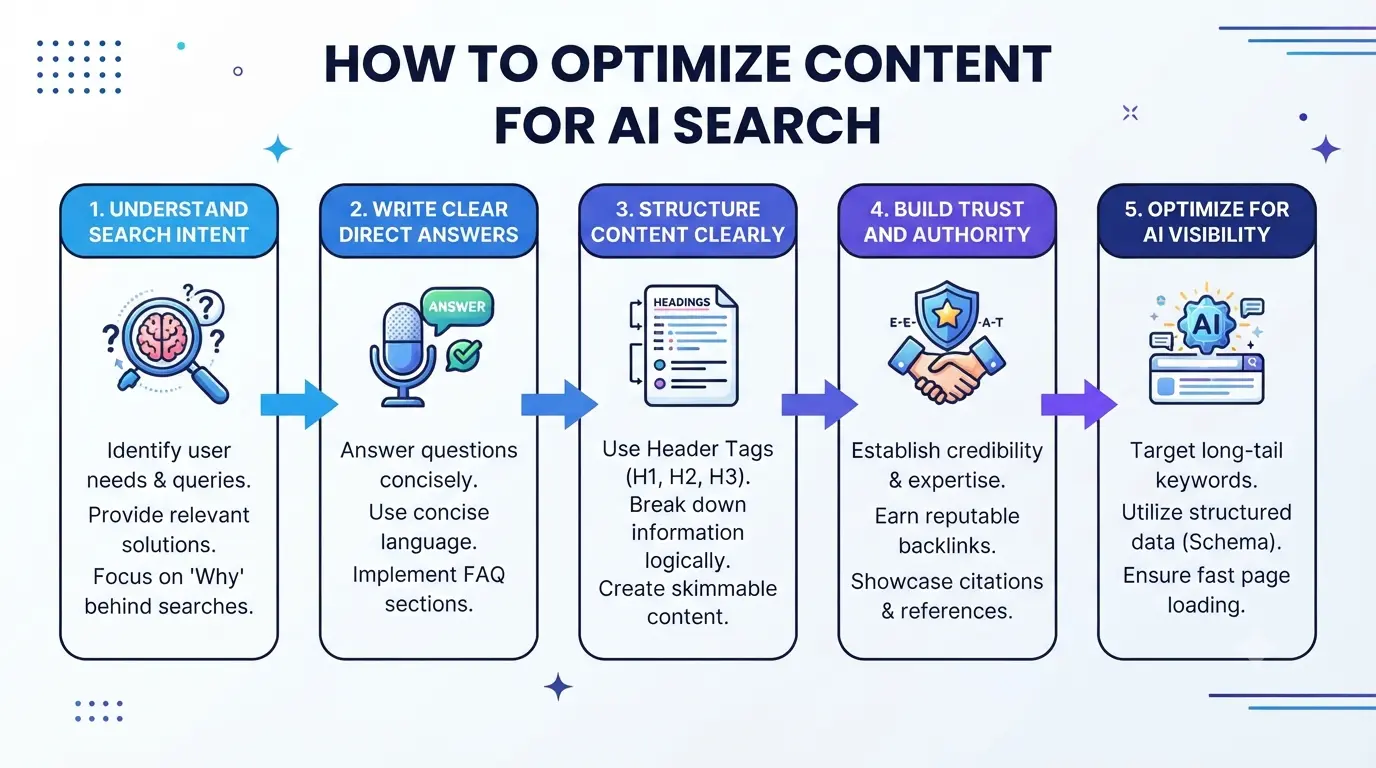
Here’s where the real work happens. These seven steps cover what actually moves the needle when you’re trying to get cited by AI systems.
Answer the Main Question Clearly
Put your answer near the top. Don’t make readers, or AI crawlers, wade through three paragraphs of throat-clearing before you get to the point. Give a direct, concise answer first. Then expand on it with detail, context, and nuance underneath. Both Profound and Elementor point to this same pattern in their research: answer-first content performs better in AI search. It’s simple. It also works.
Use Clear, Question-Based Headings
Headings do double duty now. They help human readers scan a page, and they help AI systems figure out what each section actually covers. Phrasing your H2s and H3s as real questions, the kind people actually type or ask out loud, makes it easier for AI to match your content to a query. “Benefits” as a heading tells you nothing. “What are the benefits of X?” tells an AI system exactly what to expect below it.
Cover Related Questions and Search Intent
People rarely ask one clean question and stop there. They ask follow-ups. A good page anticipates that. Look at long-tail keywords, People Also Ask boxes, and related searches for your topic, then build those questions into your content. Conversational queries are becoming the norm, especially with voice search and chat-based tools. Covering the full range of intent around a topic, not just the headline keyword, gives AI more reasons to pull from your page.
Make Content Easy to Read and Extract
AI systems favor content that’s structured cleanly. That means:
– Short paragraphs, ideally two to four sentences
– Bullet points for lists, numbered steps for processes
– Clear definitions when you introduce a term
– Examples that make abstract ideas concrete
– Sections that stand on their own, so a piece can be pulled out and still make sense
Semrush’s own recommendations line up here too, pointing toward modular, well-organized content where the important information is easy to spot at a glance. Dense walls of text don’t extract well. Structured content does.
Add Original Data, Examples and Expert Insights
This is where a lot of content falls flat. If your page just restates what everyone else already said, there’s no reason for an AI system to pick you over a competitor saying the same thing. Original research, real statistics, case studies, quotes from actual experts, first-hand experience. These things are hard to fake and hard to replicate. They give your content something a generic AI summary can’t produce on its own, which is exactly what makes it worth citing.
Strengthen Sources, Internal Links and Authority
Cite sources people already trust. Link internally to related pages on your own site so both readers and crawlers understand how your content connects. Build out topical authority by covering a subject from multiple angles across multiple pages, not just one article trying to do everything. Use credible, named authors instead of anonymous bylines. And work toward earning backlinks and brand mentions naturally, since those signals still carry weight in how AI systems judge trustworthiness.
Make Your Website Accessible to Search and AI Crawlers
None of the above matters if crawlers can’t reach your content in the first place. Check that your site is crawlable and indexable. Review your robots.txt file so you’re not accidentally blocking access. Make sure pages work well on mobile and load quickly. Use clean, accessible HTML rather than content locked behind heavy JavaScript rendering. There’s no need to chase exotic AI-specific crawler hacks here. Solid technical SEO already covers most of this ground.
How to Optimize Existing Content for AI Search
You don’t need a brand-new article for every opportunity. Often the fastest wins come from fixing what you’ve already published.
Audit Your Existing Content
Start by pulling data on your current rankings, organic traffic, and search impressions. Look for content gaps, topics you’ve never covered, or questions you’ve only answered halfway. Check whether any of your pages already show up in AI-generated answers, and note which ones don’t but probably should.
Improve Weak Sections
Once you know what’s underperforming, go fix it. Rewrite vague headings into clearer, question-based ones. Add a direct answer near the top if one’s missing. Fill in questions your competitors cover that you don’t. Drop in relevant statistics where the page currently relies on vague claims. Tighten up your internal and external linking while you’re in there.
Update and Refresh Content
Old content quietly loses value. Outdated statistics, dead links, and stale examples make a page less useful, and less useful pages get cited less often. Set a regular schedule to review older articles and refresh anything that’s aged poorly. Profound’s guidance echoes this point directly, suggesting that optimizing pages you already have often creates more AI-search opportunities than publishing something new from scratch.
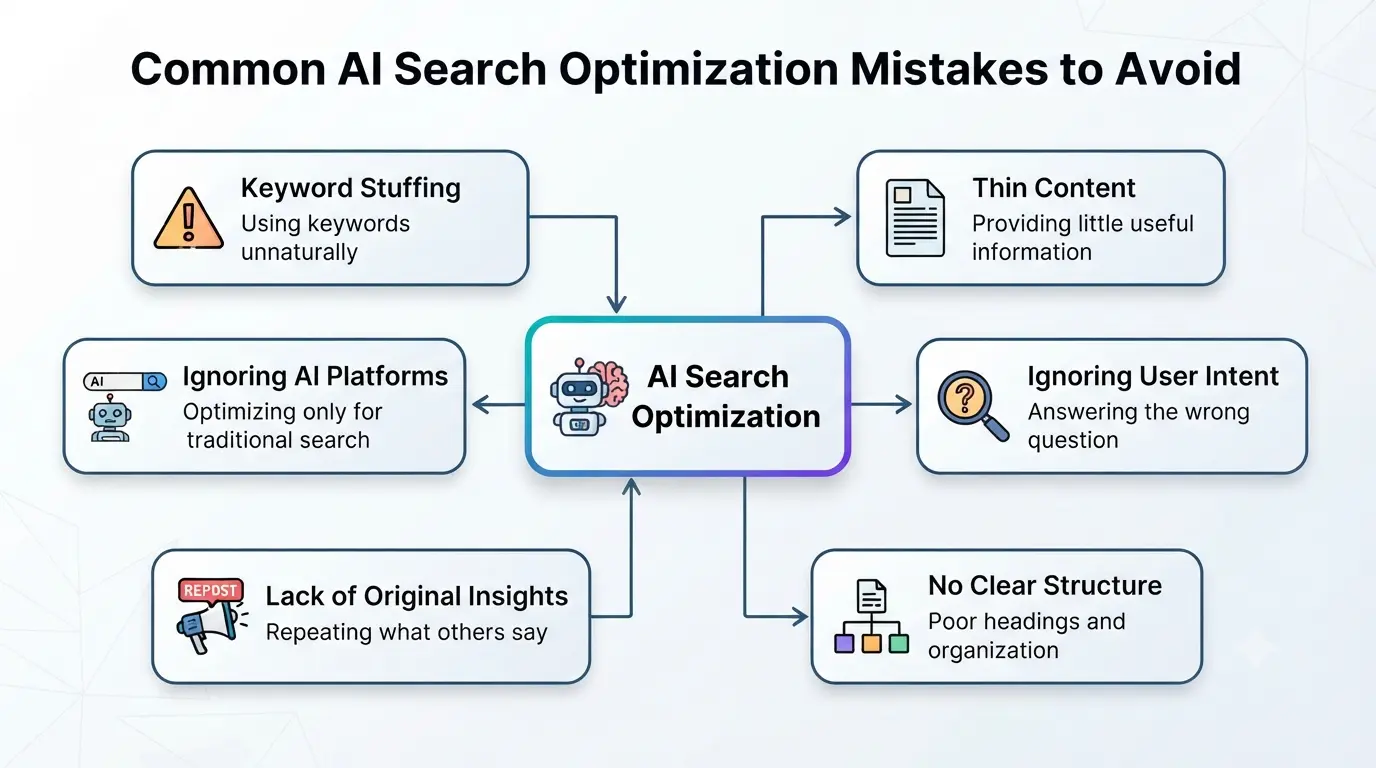
Common AI Search Optimization Mistakes to Avoid
A few habits will quietly undo all the work above.
Keyword stuffing : Repeating your target phrase unnaturally doesn’t help AI systems understand your content better. It just reads badly.
Publishing generic AI-generated content : If a chatbot could write it in thirty seconds with no unique input from you, an AI search system has little reason to cite it over the thousand other pages saying the same thing.
Writing only for AI instead of readers : Content built purely to game a citation, rather than to genuinely help someone, tends to fail both goals at once.
Ignoring traditional SEO : AI search optimization builds on SEO fundamentals. Skip those, and you’re building on sand.
Using unsupported statistics or claims : Numbers without sources hurt your credibility, and AI systems increasingly weigh trustworthiness.
Chasing unproven GEO tricks : New tactics show up constantly, promising shortcuts. Most aren’t tested, and some do more harm than good.
The bigger point underneath all of this: AI should help you create content, not replace the thinking behind it. Google has been clear that it treats mass-produced, low-value content as a problem, regardless of whether a human or a machine typed it. Originality, expertise, and editorial judgment are still what set good content apart.
How to Measure AI Search Visibility
What to Track
Keep an eye on organic impressions, clicks, and rankings as you always would. Alongside those, start tracking AI citations specifically, along with brand mentions that show up in AI-generated answers. Referral traffic from AI platforms, and how that traffic converts once it lands on your site, tells you whether the visibility is actually worth anything.
Tools to Monitor Performance
Google Search Console and Google Analytics remain your baseline for traditional performance data. Beyond that, run manual checks directly inside Google Search, ChatGPT, and Perplexity to see how often your brand or content gets referenced. A growing number of dedicated AI visibility and monitoring tools now track citations across these platforms automatically, which is worth looking into once you’re publishing at scale.
Conclusion
AI search isn’t replacing SEO. It’s adding a new layer on top of it. Clear structure helps both readers and AI systems find what they need. Direct answers make content more usable. Original data and real expertise set your work apart from generic summaries. Authority, reliable sources, and solid technical health still matter as much as they ever did, and AI visibility is worth checking regularly rather than once and forgetting about it.
As AI continues to change how people discover information, businesses need a content strategy that combines SEO, useful content, technical optimization, and digital authority. Adage Media Resources helps businesses strengthen their online presence through SEO, content marketing, and digital marketing strategies designed around evolving search behavior.
FAQs About AI Search Optimization
What is AI search optimization?
It’s the practice of structuring and writing content so AI-powered search tools can easily understand, trust, and cite it, while still ranking well in traditional search results.
Is AI SEO different from traditional SEO?
Not entirely. AI SEO adds structure and citation-friendly formatting on top of core SEO practices like relevance, quality, and technical health, rather than replacing them.
How do I optimize content for Google AI Overviews?
Follow standard SEO best practices, since Google’s AI features rely on the same core ranking systems, then add clear structure and direct answers on top.
Does AI-generated content rank on Google?
It can, but only if it’s genuinely helpful and original. Google penalizes low-value, mass-produced content regardless of how it was created.